Why We Built ShareLync
If you've ever been part of the Indian biodata-sharing process, you know the drill. Someone asks for your biodata. What happens next is one of two things:
- The WhatsApp way — You type out your details as a plain text message and hit send
- The PDF way — You create a Word document, add a photo, export as PDF, and share it
These are the two most common ways people make and share biodata in India today. And both are completely broken.
The WhatsApp Biodata Problem
Most people don't even make a proper biodata. They open WhatsApp, type out whatever details come to mind — name, age, height, job, family — hit send, and that's it. There's no format, no structure. Everyone writes it differently. Some mention income, some don't. Some add hobbies, some skip education. It's completely random. Just a wall of text with whatever the person thought of in the moment.
And the worst part? Once that message is sent, it's done. You can't edit it. You can't take it back. It just sits there — forwarded from chat to chat, group to group.
Then life happens. I moved cities. My looks changed. I switched companies. My salary went up. But that WhatsApp biodata from two years ago? Still floating around in family groups with my old city, old job, old photo. People were making decisions based on information that was completely outdated — and I had no way to fix it.
I couldn't go back and edit a WhatsApp message that had already been forwarded 50 times. I couldn't recall it from group chats I wasn't even part of. The only option was to send a "new updated biodata" — and now there are two versions out there, confusing everyone.
The PDF Problem
Some people try to be more organized. They open a Word document, type out their details, add a photo, export it as a PDF, and share it over WhatsApp. It looks more professional than a plain text message — but it has the exact same problems.
Once a PDF leaves your phone, it's gone forever. It gets forwarded to aunties, uncles, family groups, and strangers you've never met. Your personal details — salary, family background, photos — circulate endlessly with zero accountability.
Want to update a detail? Too late. The old version is already on 50 phones. Want to delete it after you find a match? Impossible. That PDF lives in WhatsApp galleries forever. And just like the text message, there's no standard format — everyone's PDF looks different, has different details, and half the time the photos don't even render properly.
Why This Became More Than Just an Inconvenience
We always knew the PDF and WhatsApp system was broken. But for the longest time, it felt like a small annoyance — not a real risk.
That changed when we started seeing what AI can do with a single photo.
In 2025, McAfee reported that 39% of Indians had come across fake AI-generated profiles. Deepfake attacks targeting women went up by 900%. Matrimonial fraud cases in India jumped 206% in one year, with losses crossing Rs 500 crore.
And it hit us — a biodata isn't just some casual document. It has your full name, your photo, your family details, your income, sometimes even your address. All in one place. Shared with people you've never met.
When you send a PDF, every person who receives it gets a permanent copy of your photo saved to their phone. They can forward it. They can screenshot it. And now, with AI tools, that one photo can be used to create a fake profile on another platform — or worse. You'd never even know, because you lost track of that PDF months ago.
We realized this isn't just a convenience problem anymore. It's a safety problem. And that's what pushed us to stop talking about "someday" and actually build something.
What If Biodata Worked Like Modern Tech?
We asked ourselves a simple question: why can't sharing a biodata be as controlled as sharing a Google Doc?
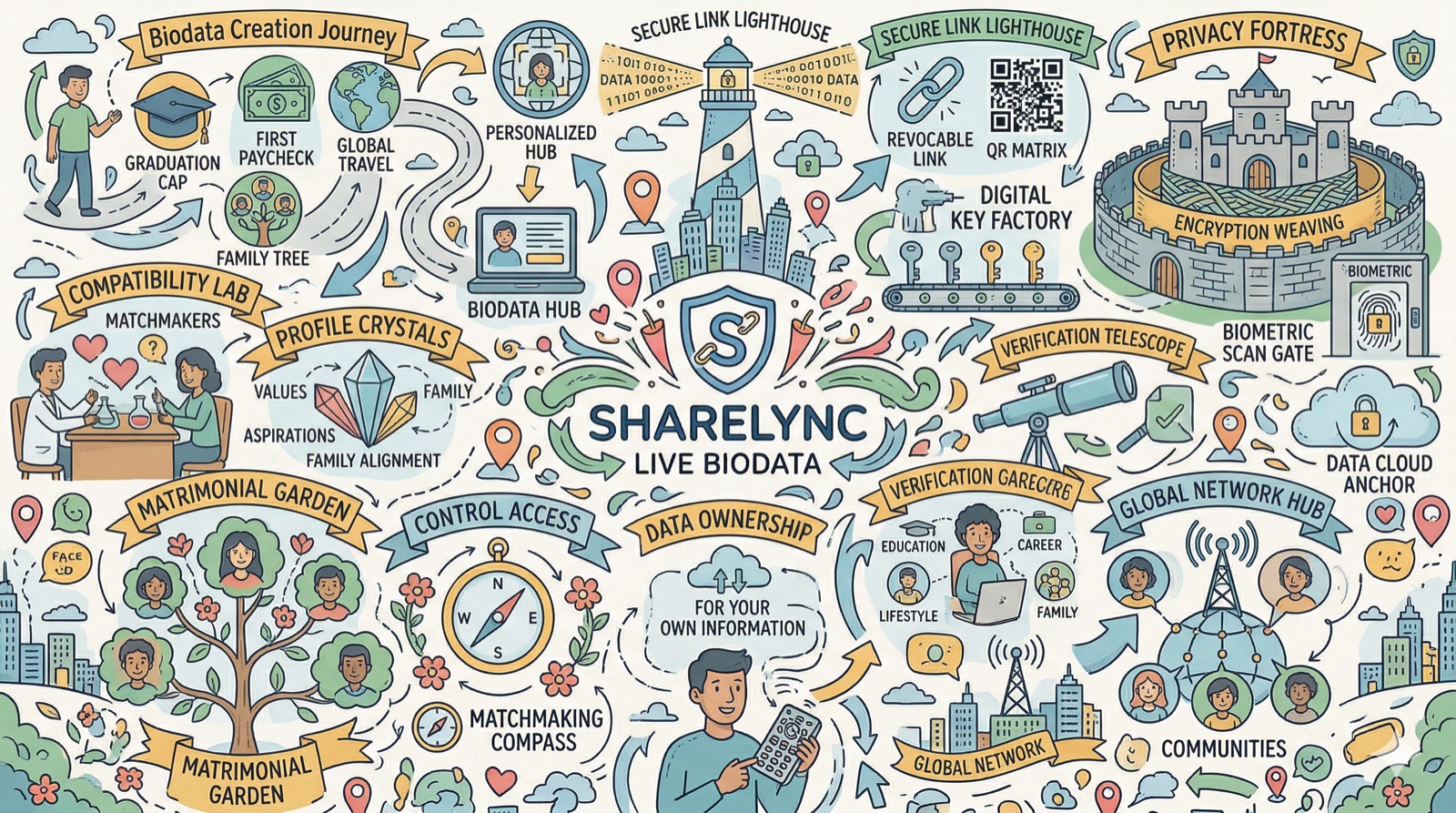
That idea became ShareLync. Here's what we wanted:
- One link, always updated — Change your details once, and everyone with the link sees the latest version
- Delete means delete — One tap, and the link stops working for everyone. No traces left behind
- Revoke access anytime — Got engaged? Taking a break? Just don't want someone seeing your biodata anymore? Turn off the link, and it stops working instantly. No need to message people asking them to delete your PDF — because there is no PDF
- Encryption by default — We wanted your data encrypted on your phone before it ever reaches our servers. The key lives only inside the link you share. We store the encrypted data, but we can't read it — because we don't have the key
- No middleman — Not even we should be able to read your profile. If our servers were ever breached, attackers would get encrypted data that is useless without the link
How It Works
ShareLync encrypts your entire biodata on your device using AES-256 encryption — the same standard used by banks. The encrypted data is stored on our servers, but the key exists only in the link you share. We literally cannot read your profile even if we wanted to.
When you share the link, the recipient's browser decrypts and displays your biodata. No app download required on their end. If you delete your profile, the encrypted data is wiped from our servers instantly. The link becomes a dead end.
Built for Real Families
We designed ShareLync for how Indian families actually share biodata:
- Parents can share the link just like they'd forward a PDF — but now it's always current
- Beautiful themes make your biodata look professional without fiddling with Word formatting
- Works in 13 languages because not everyone is comfortable in English
- Express interest lets recipients show they're interested directly from the profile
- Your data stays yours — we can't see your profile, your photos, or your family details. Everything is encrypted before it leaves your phone. We built it this way on purpose
Free, No Ads, No Catch
ShareLync is completely free. No premium tier for privacy features. No ads. We believe basic privacy shouldn't be a paid upgrade.
Try It
If you're tired of the PDF biodata circus, give ShareLync a try. Create your biodata in minutes, share it securely, and take it down whenever you want.
Make it in the ShareLync app
Create a biodata you can update
Share one link with your family. Update your details or pause sharing from the app.


Your biodata, your rules.
Ready to create yours? Check out our free marriage biodata maker guide, or jump straight to our community-specific guides: Hindu biodata format | Muslim biodata format. For tips on sharing safely, read how to share your biodata without losing control.