Hindu Marriage Biodata Format — Complete Guide with Sample & Free Maker
If you're creating a Hindu marriage biodata for the first time — or updating an old one — you know the challenge. You need the right fields, the right format, and the right level of detail. Too little and families skip you. Too much and it feels overwhelming.
This guide covers everything: what to include in a Hindu biodata, the correct order of sections, which horoscope details matter, common mistakes to avoid, and how to create a professional biodata for free in minutes.
See a live example first? View Ananya Sharma's Hindu biodata — this is what yours will look like. No app needed to view it.
What Makes a Hindu Marriage Biodata Different?
Every community has its own biodata conventions. Hindu biodatas have specific fields that families expect to see — especially around caste, gotra, horoscope details, and family religious practices. Skipping these fields when the receiving family considers them important can mean your biodata gets dismissed without a second look.
At the same time, not every Hindu family prioritizes the same things. A progressive urban family may not care about gotra or Manglik status. A traditional family may consider horoscope matching non-negotiable. The best Hindu biodata includes all relevant fields and lets each family decide what matters to them.
Complete Hindu Marriage Biodata Format
Here's the recommended structure, section by section:
1. Personal Details
| Field | Example |
|---|---|
| Full Name | Ananya Sharma |
| Date of Birth | 12 June 1997 |
| Time of Birth | 10:45 AM |
| Place of Birth | Jaipur, Rajasthan |
| Age | 28 years |
| Height | 5'9" (175 cm) |
| Marital Status | Never Married |
| Mother Tongue | Hindi |
Why time and place of birth? Many Hindu families consult a pandit for Kundli matching before proceeding. Including birth time and place upfront saves a round of back-and-forth questions.
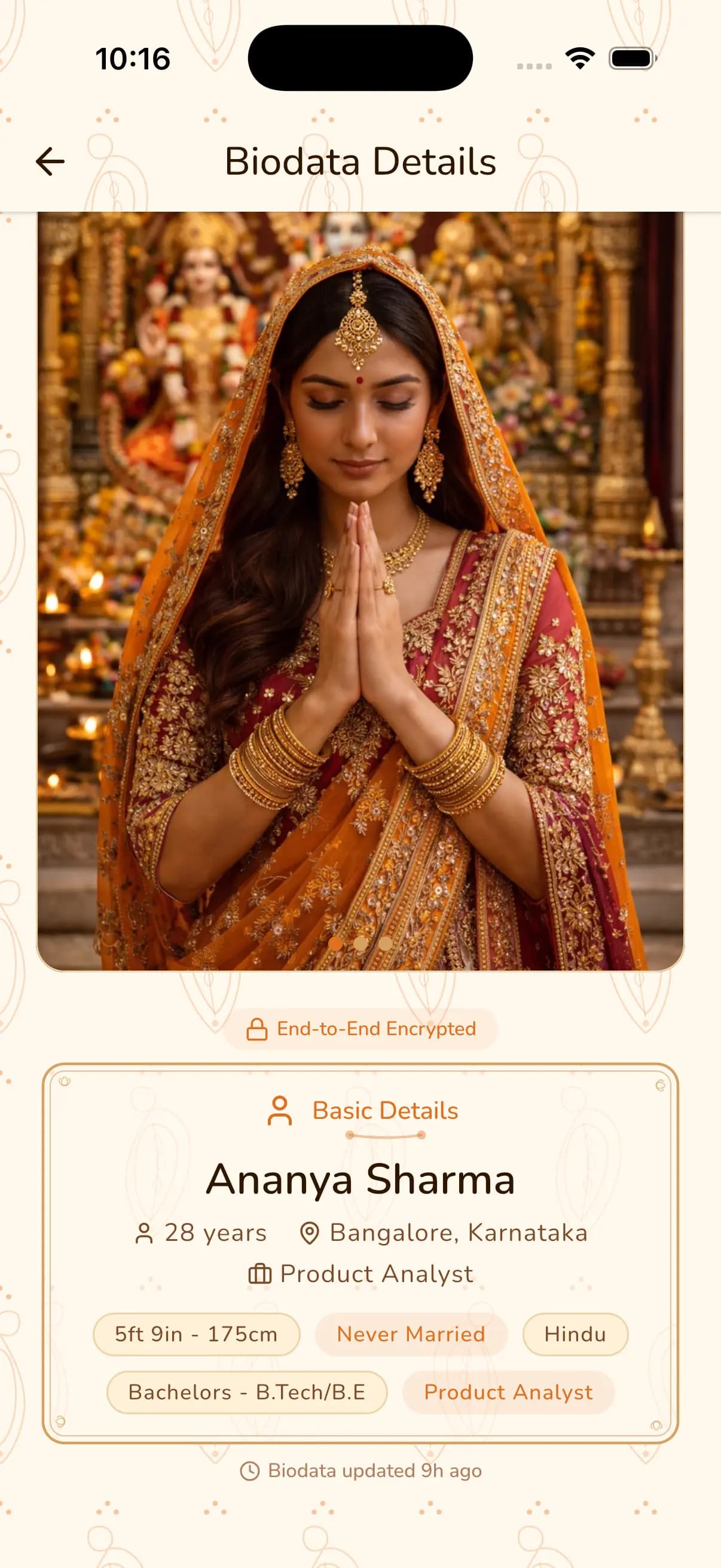
Ananya Sharma's biodata — personal details · Get ShareLync
2. Education & Career
| Field | Example |
|---|---|
| Highest Education | Bachelors - B.Tech/B.E |
| University | IIT Delhi |
| Occupation | Product Analyst |
| Employed In | Private Company |
| Company | Google India |
| Annual Income | 18-22 LPA |
| Work Location | Bangalore |
Tip: You don't need to share your exact CTC. A range is standard and expected. If you're uncomfortable sharing income at all, some families will still proceed — but most traditional families expect at least a range.
3. Cultural Background
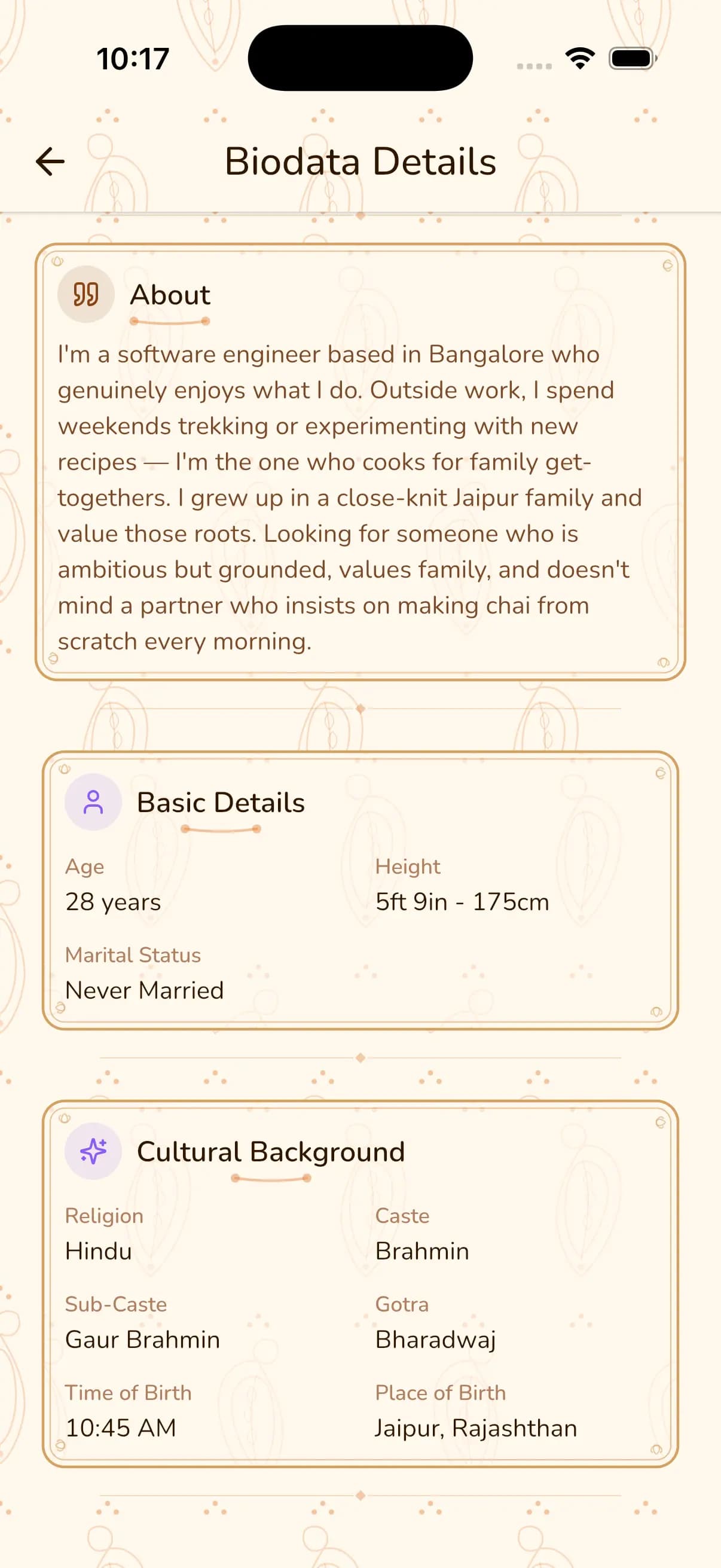
Ananya Sharma's biodata — cultural background · Get ShareLync
This is where Hindu biodatas differ most from other formats. Include what's relevant to your family:
| Field | Example |
|---|---|
| Religion | Hindu |
| Caste | Brahmin |
| Sub-caste | Gaur Brahmin |
| Gotra | Bharadwaj |
| Varna | Brahmin |
| Nakshatra (Birth Star) | Rohini |
| Rashi (Zodiac Sign) | Vrishabha (Taurus) |
| Manglik Status | Non-Manglik |
| Pada | 3rd |
| Gan | Dev |
| Nadi | Madhya |
| Family Deity (Kul Devta) | Lord Shiva |
What if you don't know your horoscope details? Ask your parents or grandparents — they almost certainly have your Janam Kundli. If not, any pandit can prepare one from your birth date, time, and place. If your family doesn't follow horoscope matching, it's fine to skip these fields — but include at least caste and gotra, as most Hindu families expect them.
A note on caste: We understand this is a sensitive topic. Many modern families are open to inter-caste alliances, while others prefer within their community. Including your caste information upfront is the norm in Hindu biodatas — it avoids awkward discoveries later in the conversation.
4. Family Information
| Field | Example |
|---|---|
| Father's Name | Mr. Rajesh Sharma |
| Father's Occupation | Retired Bank Manager |
| Mother's Name | Mrs. Sunita Sharma |
| Mother's Occupation | Homemaker |
| Siblings | 1 Sister |
| Family Type | Nuclear Family |
| Family Values | Traditional |
| Hometown/Native Place | Jaipur, Rajasthan |
Tip: "Family type" (joint vs. nuclear) and hometown matter more than you might think. Many families want to understand the living arrangement — will the couple live independently, or with the extended family?
5. Lifestyle & Preferences
| Field | Example |
|---|---|
| Diet | Vegetarian |
| Smoking | No |
| Drinking | Occasionally |
| Hobbies | Trekking, reading, cooking |
| Languages Known | Hindi, English, Rajasthani |
6. About Me
This is your chance to stand out. A good "About Me" for a Hindu biodata sounds personal and real:
"I'm a product analyst based in Bangalore who genuinely enjoys what I do. Outside work, I spend weekends trekking or experimenting with new recipes — I'm the one who cooks for family get-togethers. I grew up in a close-knit Jaipur family and value those roots. Looking for someone who is ambitious but grounded, values family, and doesn't mind a partner who insists on making chai from scratch every morning."
For tips on writing a great About Me, read 7 Common Biodata Mistakes — mistake #2 is the generic About Me problem.
7. Lifestyle Preferences (What You're Looking For)
| Field | Example |
|---|---|
| Preferred Age Range | 28-33 years |
| Preferred Height | 5'10" - 6'1" |
| Preferred Education | Graduate or above |
| Preferred Occupation | Working professional |
| Preferred Location | Metro cities |
| Preferred Diet | Vegetarian |
| Caste Preference | Same caste preferred, open to others |
| Manglik Preference | Non-Manglik preferred |
Tip: Be honest but not excessively rigid. Listing 15 requirements makes you look difficult to please. Focus on 3-4 things that genuinely matter to you and your family.
8. Photos
Include 2-4 clear, recent photos:
- One close-up face photo (natural light, no sunglasses)
- One full-length photo
- One casual/lifestyle photo (hobby, travel, etc.)
- Optional: one formal/traditional photo
Sample Hindu Marriage Biodata
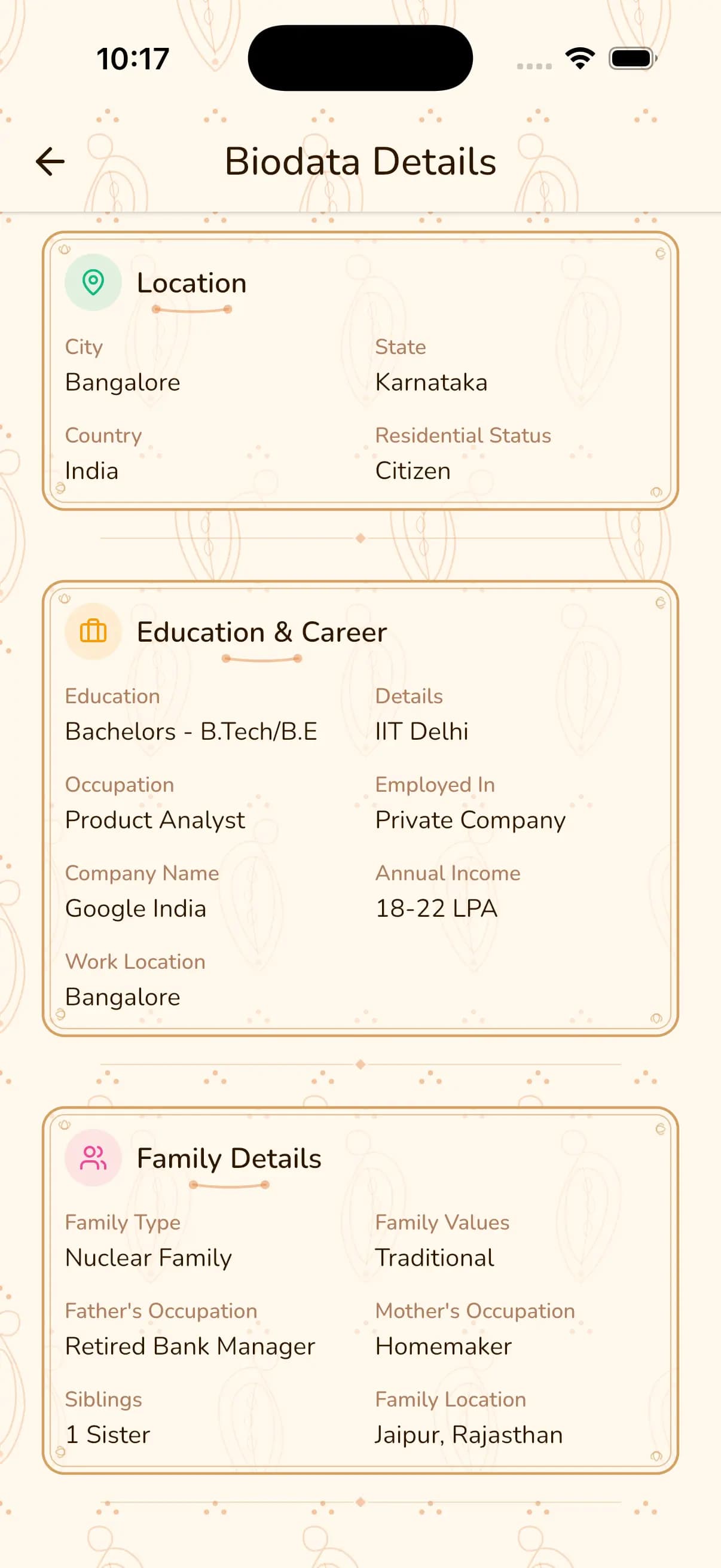
Ananya Sharma's biodata — education & family · Get ShareLync
Here's what a well-formatted Hindu biodata looks like when all the sections come together. Fields marked with * are included via the About Me section.
Ananya Sharma Age 28 | Female | 5'9" | Never Married
Hindu | Gaur Brahmin | Gotra: Bharadwaj | Non-Manglik Birth Time: 10:45 AM | Birth Place: Jaipur, Rajasthan
B.Tech/B.E (IIT Delhi) | Product Analyst at Google India (Private) | 18-22 LPA | Bangalore
Father: Rajesh Sharma (Retired Bank Manager) Mother: Sunita Sharma (Homemaker) Siblings: 1 Sister | Nuclear Family | Traditional values Family Location: Jaipur, Rajasthan
Bangalore, Karnataka | India | Citizen
Vegetarian | Non-smoker | Occasionally
"Product analyst who cooks for family get-togethers. Grew up in Jaipur, value family roots. Rohini Nakshatra, Vrishabha Rashi. Mother tongue Hindi. Hobbies: trekking, cooking, reading. Looking for someone ambitious, grounded, and okay with a partner who insists on making chai from scratch."
Common Mistakes in Hindu Biodatas
1. Missing Horoscope Details
If the receiving family practices Kundli matching, missing birth time/place means they can't proceed — and they'll move to the next biodata instead of asking you. Include it upfront.
2. Vague Caste Information
"Hindu" isn't enough for most traditional families. They want to know caste, sub-caste, and gotra. Even if you're open to inter-caste, mentioning your own background is standard practice.
3. Outdated PDF Format
A PDF created 6 months ago with your old job and old photos is still the version families are seeing. Use a format that lets you update once and have it reflect everywhere. Read our best biodata format comparison for why link-based sharing solves this.
4. No Photos or Only One Photo
Families want to see 2-4 photos. One passport-style photo isn't enough. And filtered Instagram photos erode trust. Keep it natural and recent.
5. Generic About Me
"Simple, family-oriented person from a respectable family." This describes everyone. Write something real. See our biodata mistakes guide for examples of how to fix this.
How to Create a Hindu Marriage Biodata for Free
You have several options:
Word/Google Docs — Free but time-consuming. You format everything yourself. Output is a PDF that can't be updated or deleted after sharing. Takes 30-60 minutes.
Canva — Beautiful Hindu biodata templates. Free for most designs. Still exports as PDF with all the same control problems. Takes 15-30 minutes. See our Canva vs. ShareLync comparison.
ShareLync — Free biodata maker app that creates an encrypted link instead of a PDF. Has dedicated Hindu-specific fields and a flexible About Me section for additional details. AI parser can convert your existing biodata automatically. Update and delete anytime. Takes 5 minutes.
For a detailed comparison of all biodata makers, read our marriage biodata maker guide.
What ShareLync Supports for Hindu Biodatas
ShareLync covers all the fields that matter for a Hindu biodata — personal details, caste, sub-caste, gotra, Manglik status, birth time, birth place, nakshatra, rashi, education, career, income, family details, diet, lifestyle, and more — all in one clean, encrypted profile.
Frequently Asked Questions
Is gotra mandatory in a Hindu biodata?
It depends on the family. Traditional families — especially in North India — consider gotra important for compatibility (same gotra is often avoided). If you know your gotra, include it. If you don't, ask your parents or simply note "To be discussed."
Should I include Manglik status?
If your family follows Vedic astrology, yes. Manglik status is one of the first things many families check. If you're Non-Manglik, saying so upfront avoids unnecessary questions. If you are Manglik, stating it honestly saves time — many families are open to Manglik matches, especially with remedies.
What if I don't want to mention caste?
That's your choice. Some modern families prefer not to include caste information. However, most Hindu biodata recipients expect it. One practical approach: include your caste but note "Open to all castes" in your preferences section.
How is a Hindu biodata different from a Muslim or Sikh biodata?
The main differences are in the cultural/religious fields. Hindu biodatas include gotra, nakshatra, rashi, and Manglik status. Muslim biodatas include maslak, Quran memorization, and religious practice level. Sikh biodatas include Amritdhari/Keshdhari status and turban details — see our Sikh biodata format guide. The basic structure (personal, education, family, lifestyle) is the same across all communities.
Can I create a Hindu biodata online for free?
Yes. ShareLync is a free biodata maker that includes all Hindu-specific fields. You can create a biodata in 5 minutes — including horoscope details, caste, gotra, and community fields — and share it as a secure, encrypted link.
Create Your Hindu Marriage Biodata Now
Skip the Word formatting struggle. Create a professional Hindu biodata with all the right fields — gotra, nakshatra, caste, Manglik status — in 5 minutes. Free, encrypted, and shareable as a link. See a live example here.
Make it in the ShareLync app
Create a biodata you can update
Share one link with your family. Update your details or pause sharing from the app.


Your biodata should be as thoughtful as your family's search.
Related guides: Muslim biodata format | Sikh biodata format | Best biodata format comparison | Common biodata mistakes