
Sikh Marriage Biodata Format — Complete Guide with Sample & Free Maker
Creating a marriage biodata as a Sikh family has its own conventions. Beyond the standard personal and career details, Sikh biodatas include fields around religious observance, turban, caste, and family background that families pay close attention to.
Whether your family is Amritdhari, Keshdhari, or Sehajdhari — this guide covers the right sections, the right order, which Sikh-specific fields to include, common mistakes to avoid, and how to create a professional Sikh biodata for free in minutes.
See a live example first? View Harpreet Kaur's Sikh biodata — this is what yours will look like. No app needed to view it.
What Makes a Sikh Marriage Biodata Different?
Sikh biodatas share the same basic structure as any marriage biodata — personal details, education, career, family. But they include fields specific to the Sikh community that families expect:
- Amritdhari / Keshdhari / Sehajdhari — Level of Sikh religious observance
- Turban — Whether the person wears a turban (dastar)
- Caste — Jat, Khatri, Arora, Ramgarhia, Ravidassia, etc.
- Gurdwara attendance — Regular sangat participation
- Family's level of observance — Amritdhari household or not
For many Sikh families, whether the person is Amritdhari (baptized) is the most important compatibility factor — more important than education or income. A biodata that skips this detail will often be set aside immediately.
Complete Sikh Marriage Biodata Format
Here's the recommended structure, section by section:
1. Personal Details
| Field | Example |
|---|---|
| Full Name | Harpreet Kaur |
| Date of Birth | 20 November 1998 |
| Age | 27 years |
| Height | 5'8" (172 cm) |
| Marital Status | Never Married |
| Mother Tongue | Punjabi |
| Languages Known | Punjabi, English, Hindi |
| Current City | Chandigarh |
| Nationality | Indian |
Tip: Including "Kaur" or "Singh" in the name is standard and expected in Sikh biodatas. It immediately signals your community identity.
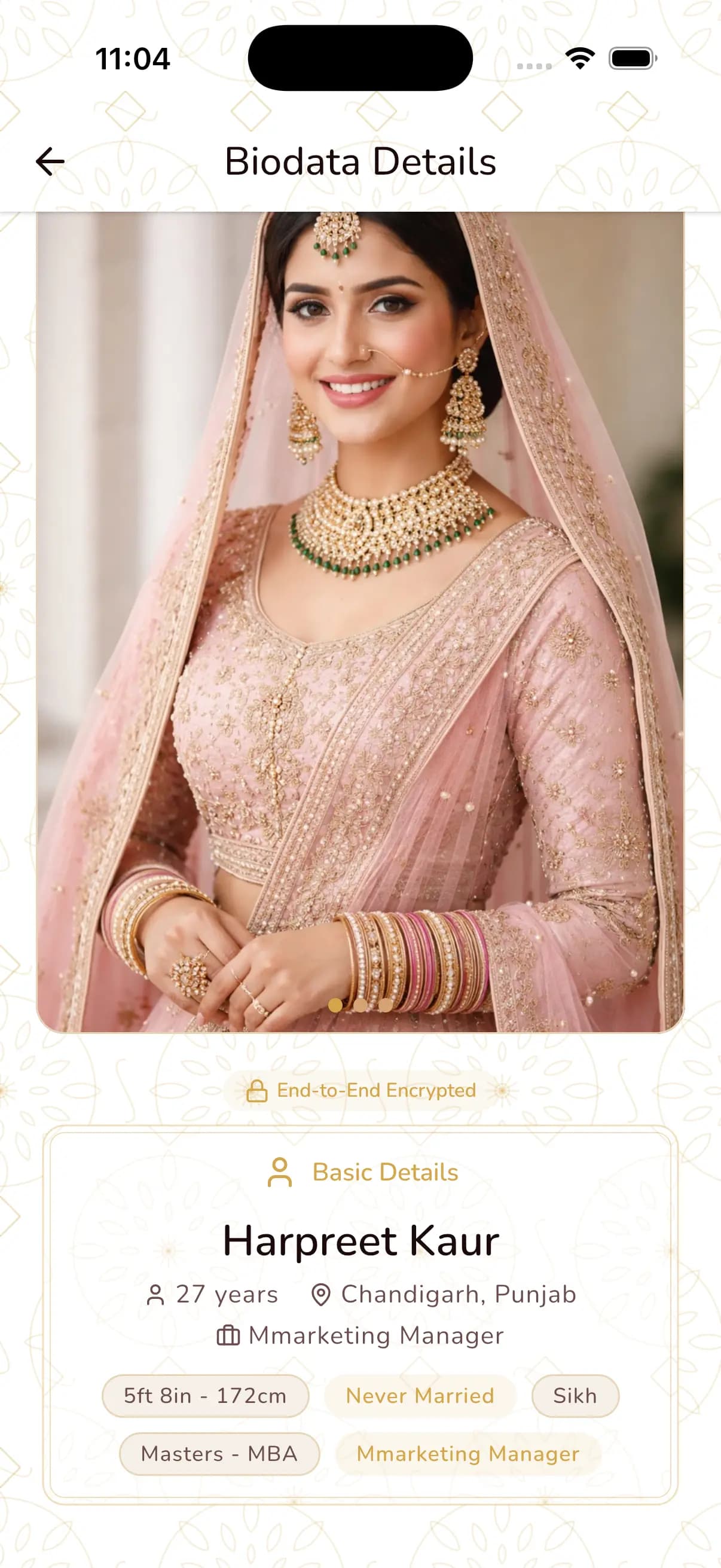
Harpreet Kaur's biodata — personal details · Get ShareLync
2. Religious Background
This is the most important section of a Sikh biodata. Families assess compatibility here first.
| Field | Example |
|---|---|
| Religion | Sikh |
| Amritdhari / Keshdhari / Sehajdhari | Keshdhari |
| Turban (Dastar) | Yes |
| Baptized (Amrit Chhak) | No, but from Amritdhari family |
| Gurdwara Attendance | Regular (weekly sangat) |
| Nitnem (Daily Prayers) | Japji Sahib and Rehras Sahib daily |
| Kirtan / Seva | Active in Gurdwara kirtan seva |
| Non-veg / Vegetarian | Vegetarian (lacto) |
Why this matters so much: The Amritdhari / Keshdhari / Sehajdhari distinction is often the first filter for Sikh families. An Amritdhari family looking for an Amritdhari match will skip a biodata that doesn't state this clearly. Similarly, a Sehajdhari family may be put off by rigid expectations. Be honest about where you and your family stand.
Turban is non-negotiable for many families. Whether a Sikh man wears a turban (and whether a Sikh woman wears a dastar) is a deeply personal decision — and a key compatibility factor. State it clearly upfront.
3. Cultural Background
| Field | Example |
|---|---|
| Caste | Jat Sikh |
| Sub-caste / Clan (Got) | Sandhu |
| Native Region | Majha (Amritsar) |
A note on caste: The Sikh faith emphasizes equality and rejects caste distinctions. However, in practice, caste remains a factor in many Sikh marriage decisions. Jat, Khatri, Arora, Ramgarhia, Ravidassia, and other communities often prefer matches within their group. Including your caste is the norm — it avoids confusion later, even if your family is open to inter-caste alliances.
4. Education & Career
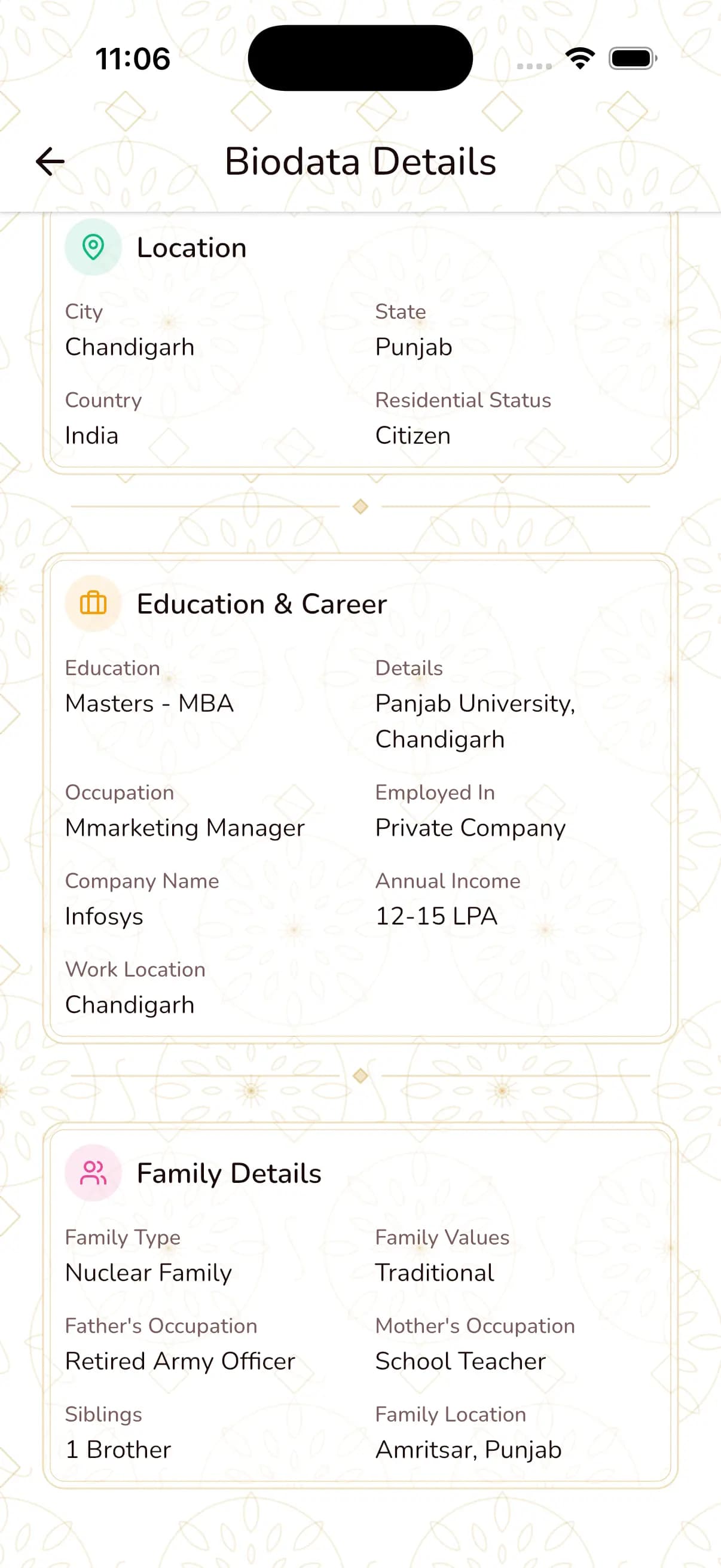
Harpreet Kaur's biodata — education & family · Get ShareLync
| Field | Example |
|---|---|
| Highest Education | Masters - MBA |
| University | Panjab University, Chandigarh |
| Occupation | Marketing Manager |
| Employed In | Private Company |
| Company | Infosys |
| Annual Income | 12-15 LPA |
| Work Location | Chandigarh |
5. Family Information
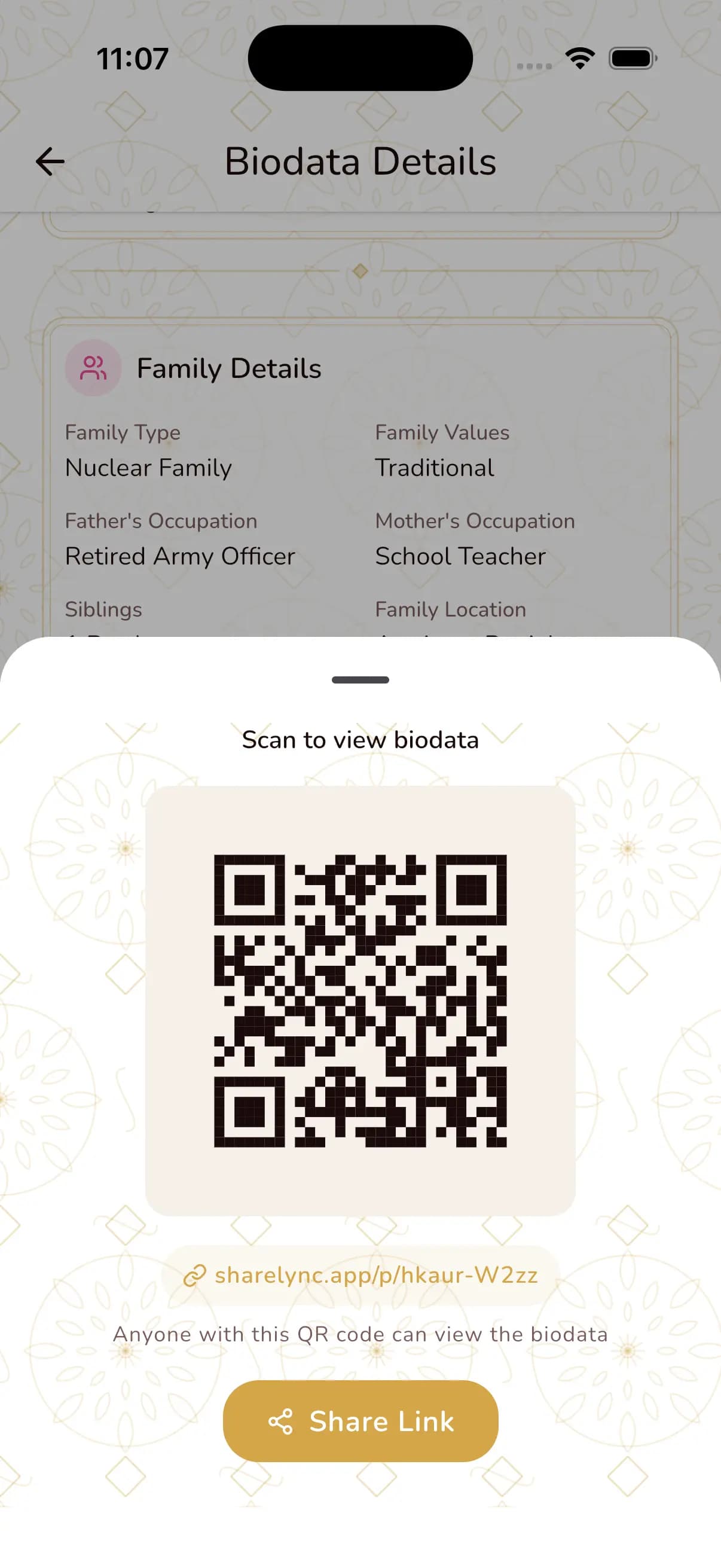
Harpreet Kaur's biodata — family & sharing · Get ShareLync
| Field | Example |
|---|---|
| Father's Name | S. Gurpreet Singh |
| Father's Occupation | Retired Army Officer |
| Mother's Name | Mrs. Manpreet Kaur |
| Mother's Occupation | School Teacher |
| Siblings | 1 Brother (elder, married, engineer) |
| Family Type | Nuclear Family |
| Family Values | Traditional |
| Family's Religious Observance | Keshdhari household, regular at Gurdwara |
| Hometown | Amritsar, Punjab |
Tip: "Family's religious observance" is unique to Sikh biodatas and very important. Families want to know if the household is Amritdhari, Keshdhari, or more relaxed in practice. A simple line communicates a lot about the home environment.
6. Lifestyle
| Field | Example |
|---|---|
| Diet | Vegetarian |
| Smoking | No |
| Drinking | No |
| Hobbies | Kirtan, gatka, reading Sikh history, cooking |
| Travel | Visited Harmandir Sahib (Golden Temple) annually |
Tip: Mentioning visits to Sikh holy sites (Harmandir Sahib, Hemkund Sahib, Takht Sri Patna Sahib) signals religious commitment. If you practice gatka (Sikh martial art) or participate in kirtan, mention it — these are valued in the community.
7. About Me
A genuine "About Me" that reflects your personality and values:
"I'm a marketing professional based in Chandigarh who grew up in an Amritsar household steeped in Sikhi. My mornings start with Japji Sahib and my weekends revolve around Gurdwara seva, family lunches, and the occasional road trip to the mountains. I'm Keshdhari and proud of it — my turban is part of who I am. Looking for someone who values family, has a connection with Gurbani, and won't judge my obsession with Amritsari kulche."
Write something real. Avoid generic lines like "Simple Sikh girl from a good family." That tells families nothing about who you actually are.
8. What You're Looking For
| Field | Example |
|---|---|
| Preferred Age Range | 28-33 years |
| Preferred Height | 5'8" - 6'1" |
| Preferred Education | Graduate or above |
| Preferred Occupation | Working professional |
| Preferred Location | Punjab or metro cities |
| Preferred Diet | Vegetarian |
| Religious Observance | Keshdhari or Amritdhari |
| Turban | Preferred |
| Caste Preference | Jat Sikh preferred, open to others |
Tip: Be honest about turban preference. Many Sikh women (and their families) have a strong preference for turbaned men. Stating this upfront avoids awkward conversations later.
9. Photos
Include 2-4 clear, recent photos:
- One close-up face photo (natural light, clear face)
- One full-length photo
- One casual/lifestyle photo
- Optional: one photo in traditional Sikh attire (turban, salwar suit, etc.)
For men: If you wear a turban, include at least one photo with your turban properly tied. This is what families want to see first.
Sample Sikh Marriage Biodata
Here's what a well-structured Sikh biodata looks like when all sections come together.
Harpreet Kaur Age 27 | Female | 5'8" | Never Married
Sikh | Jat Sikh | Got: Sandhu | Keshdhari Native Region: Majha (Amritsar)
Masters MBA (Panjab University) | Marketing Manager at Infosys (Private) | 12-15 LPA | Chandigarh
Father: S. Gurpreet Singh (Retired Army Officer) Mother: Manpreet Kaur (School Teacher) Siblings: 1 Brother | Nuclear Family | Traditional values Keshdhari household, regular at Gurdwara Family Location: Amritsar, Punjab
India | Punjab | Chandigarh | Citizen
Vegetarian | Non-smoker | Non-drinker
"Marketing professional from Amritsar. Mornings start with Japji Sahib, weekends with Gurdwara seva and family. Keshdhari, turban is part of who I am. Active in kirtan seva. Hobbies: gatka, reading Sikh history, cooking. Looking for someone who values family, connects with Gurbani, and won't judge my kulche obsession."
Common Mistakes in Sikh Biodatas
1. Not Stating Amritdhari/Keshdhari/Sehajdhari Status
This is the #1 filter for most Sikh families. Skipping it means your biodata gets set aside by families who need this information to proceed. State it clearly in the first few lines.
2. Unclear About Turban
"Sikh" alone doesn't tell families whether the person wears a turban. For men, this is one of the first things families check. For women who wear a dastar, stating it is equally important. Don't leave it ambiguous.
3. Vague About Family's Religious Practice
"Religious family" could mean anything. "Amritdhari household, regular at Gurdwara, all family members keep kesh" — that communicates clearly. Sikh families assess compatibility through the household's level of observance.
4. Using an Outdated PDF
Same problem every community faces — a PDF from months ago with old details still circulating. Use a format that lets you update once and reflect everywhere. Read our best biodata format comparison for why link-based sharing solves this.
5. Generic About Me
"Simple, religious Sikh girl from a good family seeking a compatible match." This describes thousands of people. Write about what makes you specifically you — your connection to Sikhi, your hobbies, your personality. See our biodata mistakes guide for more examples.
How to Create a Sikh Marriage Biodata for Free
Document editors — Free but time-consuming. You format everything yourself and export as a PDF you can't update or delete. Takes 30-60 minutes.
Online template tools — Better design, but still output a PDF with the same control problems. Takes 15-30 minutes.
ShareLync — Free biodata maker app that creates an encrypted link instead of a PDF. AI parser can convert your existing biodata automatically. Update and delete anytime. Takes 5 minutes.
For a detailed comparison of all tools, read our marriage biodata maker guide.
What ShareLync Supports for Sikh Biodatas
ShareLync covers all the fields that matter for a Sikh biodata — personal details, religion, caste, sub-caste, Amritdhari/Keshdhari status, turban, education, career, income, family details, family values, diet, lifestyle, Nitnem practice, Gurdwara involvement, and more — all in one clean, encrypted profile.
Frequently Asked Questions
Is caste important in a Sikh biodata?
The Sikh faith rejects caste distinctions, but in practice, many Sikh families still prefer matches within their caste group (Jat, Khatri, Arora, Ramgarhia, etc.). Including your caste is standard practice — it avoids surprises later. If you're open to all castes, mention that in your preferences.
Should I mention Amritdhari status even if I'm Sehajdhari?
Yes. Sehajdhari is a valid and respected level of Sikh observance. Stating it honestly helps families understand your lifestyle and avoids mismatched expectations. Many Sehajdhari families specifically look for other Sehajdhari matches.
How is a Sikh biodata different from a Hindu biodata?
The main differences are in the religious fields. Sikh biodatas include Amritdhari/Keshdhari/Sehajdhari status, turban details, Nitnem practice, and Gurdwara involvement. Hindu biodatas include gotra, nakshatra, rashi, and Manglik status. The basic structure (personal, education, family, lifestyle) is the same. For Hindu-specific details, see our Hindu biodata format guide.
What does Amritdhari, Keshdhari, and Sehajdhari mean?
Amritdhari means the person has taken Amrit (Sikh baptism) and follows the full Khalsa discipline — including the five Kakars (Kesh, Kangha, Kara, Kachera, Kirpan). Keshdhari means the person keeps uncut hair (kesh) and follows Sikh practices but hasn't taken Amrit. Sehajdhari means the person identifies as Sikh but may cut their hair and follows Sikhi at their own pace.
Can I create a Sikh biodata online for free?
Yes. ShareLync is a free biodata maker that supports all Sikh-specific details. You can create a biodata in 5 minutes and share it as a secure, encrypted link that you can update or delete anytime.
Create Your Sikh Marriage Biodata Now
Skip the formatting struggle. Create a professional Sikh biodata with all the right fields — Amritdhari status, turban, caste, family observance — in 5 minutes. Free, encrypted, and shareable as a link. See Harpreet Kaur's live example here.
Make it in the ShareLync app
Create a biodata you can update
Share one link with your family. Update your details or pause sharing from the app.


Your biodata should reflect your values — and protect your privacy while doing it.
Related guides: Hindu biodata format | Muslim biodata format | Best biodata format comparison | Common biodata mistakes