
Biodata Format for Marriage: The Complete 2026 Guide (Free Templates & Samples)
Creating a biodata for marriage is one of the most important steps a family takes during the marriage process. It's the first impression — a single document that represents not just one person, but an entire family's values, background, and aspirations.
Yet, most people struggle with the basics. What sections should you include? What format works best? How detailed should the family information be? Should you include a photo? What about salary?
This guide answers every question. Whether you're creating a biodata for a son, daughter, brother, or sister, you'll find the right format, real examples, and practical advice to create a biodata that families take seriously.
What Is a Marriage Biodata?
A marriage biodata is a structured document that summarizes a person's personal, educational, professional, and family details for the purpose of marriage. It is shared among families — typically by parents, siblings, or close relatives — to evaluate compatibility before families meet in person.
The document goes by many names: wedding biodata, marriage profile, matrimonial profile, or simply biodata. They all mean the same thing, and the format in this guide covers them all.
Unlike a resume (which focuses on career), a biodata focuses on the whole person: their upbringing, values, family background, lifestyle, and what they're looking for in a life partner.
A good biodata is:
- Complete — Covers all the sections families expect to see
- Honest — Accurately represents the person without exaggeration
- Well-formatted — Easy to read, clean, and organized
- Respectful — Written in a tone that reflects well on the family
Make a Biodata You Can Keep Updated
A simple marriage biodata includes personal details, education, career, family background, cultural background, interests, partner preferences and contact details. Add a photo only when the person agrees to share it.
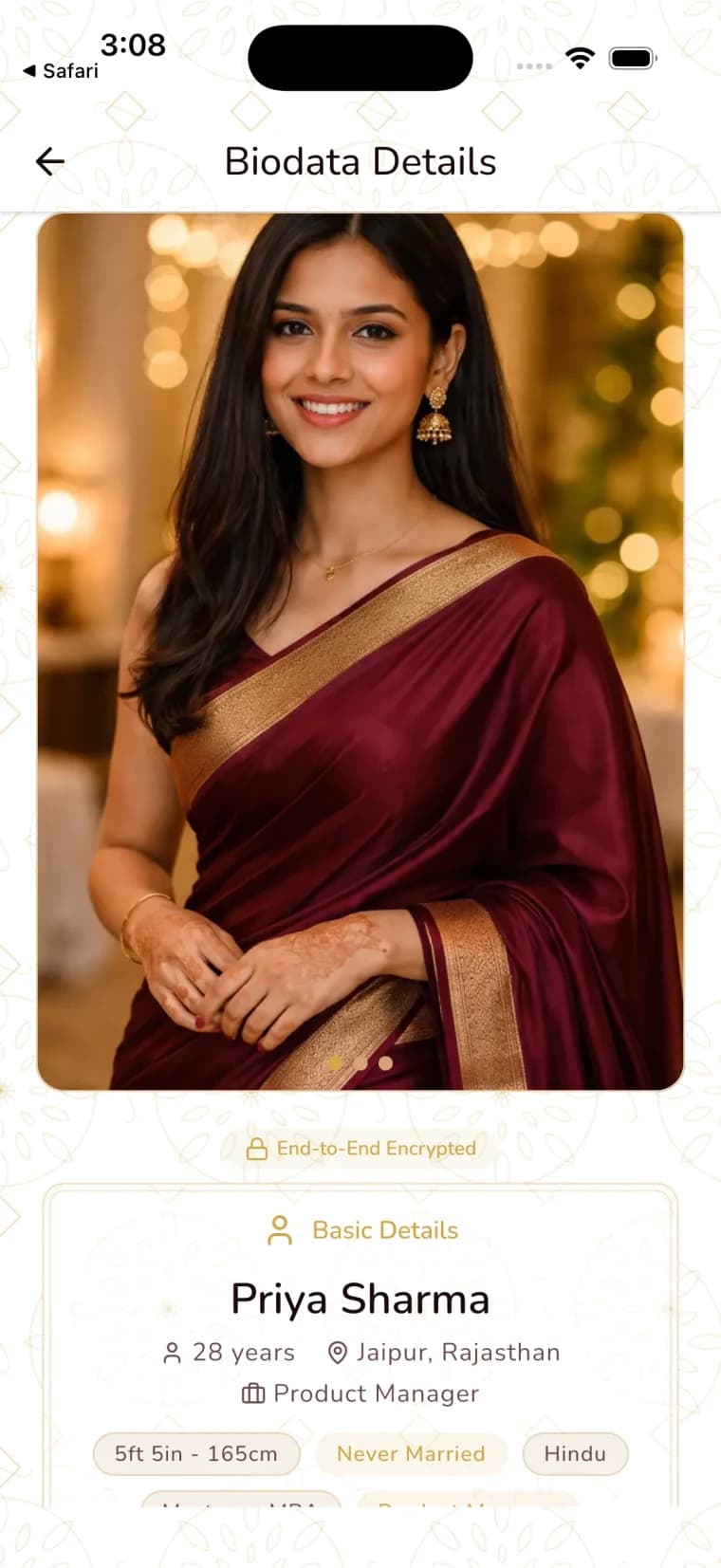
ShareLync lets you add these details in the app, choose a theme and share a link. You can also import an existing PDF and review the extracted details before saving.
When your details change, update the biodata. Families who open the same active link see the latest details. You can pause a sharing view when you want to stop access through that link.
The app supports 16 languages. Creation happens in the app; recipients can read the link in a browser. A recipient may save information or capture the screen. Pausing a link cannot remove those copies.
Make it in the ShareLync app
Create your biodata without formatting a document
Add your details in ShareLync, choose a theme and share an updatable link with your family.


What to Include in Your Biodata
Every biodata should cover these core sections. Think of this as your checklist:
1. Personal Information
- Full name
- Date of birth (and time of birth, if relevant for horoscope)
- Height
- Complexion (optional — increasingly left out in modern biodatas)
- Blood group (optional)
- Place of birth
- Current city of residence
- Nationality / citizenship
2. Education
- Highest qualification (degree, university, year of passing)
- Any additional certifications or ongoing studies
- School name (optional, but common in some communities)
3. Career and Professional Details
- Current designation and company
- Field of work (IT, medicine, business, civil services, etc.)
- Annual income (can be a range — more on this in the FAQ)
- Work location
If you're a working professional in IT, medicine, finance, or similar fields, we have a dedicated guide on writing a biodata that does justice to your career.
4. Family Details
- Father's name, occupation, and retirement status (if applicable)
- Mother's name, occupation
- Number of siblings, their names, marital status, and occupations
- Family type: joint or nuclear
- Native place / ancestral village or town
5. Religious and Community Details
- Religion
- Caste / sub-caste (if applicable)
- Gotra (for Hindu and Jain families)
- Nakshatra / Rashi (if horoscope is relevant)
- Manglik status (for Hindu families)
6. Lifestyle and Interests
- Diet: vegetarian, non-vegetarian, eggetarian, Jain
- Hobbies and interests
- Languages spoken
7. Expectations from Life Partner
- Preferred education, career background
- Age range
- Location preferences
- Any specific values or qualities
For a deep dive on this section, read our guide: What to Write in the Expectations Section of Your Biodata
8. Contact Information
- Parent's or guardian's phone number
- Email address
- Biodata link (if using a shareable link instead of a static document)
9. Photo
- A recent, clear photo (we discuss placement and best practices later in this guide)
Biodata Format for Boy
Here is a complete sample biodata format for a boy. This follows a traditional structure that families across India are comfortable with.
BIODATA FOR MARRIAGE
Personal Details
| Name | Arjun Rajesh Sharma |
| Date of Birth | 14 March 1996 (Age: 29) |
| Height | 5'10" |
| Place of Birth | Pune, Maharashtra |
| Current City | Bangalore, Karnataka |
| Religion | Hindu |
| Caste | Brahmin (Deshastha) |
| Gotra | Kashyap |
| Manglik | No |
| Mother Tongue | Marathi |
Education and Career
| Education | B.Tech (Computer Science), VIT Pune, 2018 |
| Higher Education | M.S. (Data Science), BITS Pilani, 2021 |
| Occupation | Senior Software Engineer |
| Company | Leading MNC, Bangalore |
| Annual Income | 18-22 LPA |
Family Details
| Father | Mr. Rajesh Vinod Sharma — Retired Bank Manager (SBI) |
| Mother | Mrs. Sunita Rajesh Sharma — Homemaker |
| Brother | Karan Sharma (Elder) — Married, Software Engineer, Pune |
| Sister | Priya Sharma (Younger) — B.Com Final Year |
| Family Type | Nuclear |
| Native Place | Satara, Maharashtra |
Lifestyle
| Diet | Vegetarian |
| Hobbies | Cricket, reading, trekking, cooking |
| Languages | Marathi, Hindi, English |
Expectations
Looking for a well-educated, family-oriented girl with a kind and understanding nature. Preference for someone with a professional background in IT, medicine, or education. Should be open to living in Bangalore or willing to relocate.
Contact
| Father's Phone | +91-98XXX-XXXXX |
| sharma.family@email.com | |
| Biodata Link | sharelync.app/arjun-s |
This format works well because it's organized in clear sections, includes all the information families look for, and presents details in a table layout that's easy to scan.
Biodata Format for Girl
Here is a complete sample biodata format for a girl. Note the subtle differences in how certain details are presented.
BIODATA FOR MARRIAGE
Personal Details
| Name | Sneha Anil Kulkarni |
| Date of Birth | 22 August 1997 (Age: 28) |
| Height | 5'4" |
| Place of Birth | Nagpur, Maharashtra |
| Current City | Mumbai, Maharashtra |
| Religion | Hindu |
| Caste | Maratha (96 Kuli) |
| Gotra | Bharadwaj |
| Manglik | No |
| Mother Tongue | Marathi |
Education and Career
| Education | MBBS, Government Medical College, Nagpur, 2021 |
| Higher Education | MD (Dermatology) — Currently in 2nd year, Mumbai |
| Occupation | Resident Doctor |
| Hospital | KEM Hospital, Mumbai |
Family Details
| Father | Mr. Anil Prakash Kulkarni — Civil Engineer, PWD (Class 1 Officer) |
| Mother | Mrs. Anita Anil Kulkarni — School Principal (Retired) |
| Brother | Rohit Kulkarni (Elder) — Married, CA, Pune |
| Sister | None |
| Family Type | Nuclear |
| Native Place | Amravati, Maharashtra |
| Own House | Yes (Nagpur and Mumbai) |
Lifestyle
| Diet | Vegetarian |
| Hobbies | Painting, yoga, reading, classical music |
| Languages | Marathi, Hindi, English |
Expectations
Looking for a well-educated, progressive, and respectful boy from a good family background. Preference for someone working in IT, medicine, civil services, or business. Should value education and respect for elders. Open to boys settled in Maharashtra or Bangalore.
Contact
| Father's Phone | +91-97XXX-XXXXX |
| kulkarni.family@email.com | |
| Biodata Link | sharelync.app/sneha-k |
Tip: Many families include details like "Own House" or "Family Property" in the girl's biodata as it signals financial stability. This is common and perfectly appropriate.
Biodata Format by Religion and Community
While the core structure remains the same, certain communities emphasize different details. Here's what varies:
Hindu Biodata Format
Hindu biodatas typically include:
- Gotra — Essential for families that follow gotra-based compatibility
- Nakshatra and Rashi — For horoscope (kundali) compatibility
- Manglik status — Whether the person is Manglik or Non-Manglik
- Kul-devta / Kul-devi — Family deity (common in Marathi, Gujarati, and South Indian families)
- Varna — Brahmin, Kshatriya, Vaishya, Shudra (less common in modern biodatas, but still relevant in some families)
Muslim Biodata Format
Muslim biodatas typically include:
- Sect — Sunni, Shia, or other
- Maslak — Deobandi, Barelvi, Ahle Hadith, etc.
- Madrasa education (if applicable, alongside formal education)
- Hafiz-e-Quran status (if applicable)
- Mehr expectations (sometimes mentioned by the girl's family)
The term "biodata" is widely used in Muslim families across India, though some families prefer to call it a "profile" or "introduction."
Sikh Biodata Format
Sikh biodatas typically include:
- Amritdhari / Keshdhari / Sehajdhari status
- Gurdwara affiliation (sometimes)
- Caste — Jat, Khatri, Ramgarhia, Arora, etc. (still relevant for many families)
- Family's connection to Punjab — Even if settled elsewhere, the ancestral village in Punjab is usually mentioned
Christian Biodata Format
Christian biodatas typically include:
- Denomination — Catholic, Protestant, Syro-Malabar, CSI, CNI, Marthoma, Pentecostal, etc.
- Parish / Church name
- Diocese
- Active involvement in church (choir, youth group, etc.)
Christian biodatas in India tend to be slightly shorter and less focused on sub-caste details, though community and denomination remain important.
Jain Biodata Format
Jain biodatas typically include:
- Sect — Digambara or Shvetambara
- Sub-sect — Agrawal, Khandelwal, Porwal, Oswal, etc.
- Gotra
- Strict dietary preferences — Many Jain families mention whether the person follows a strict Jain diet (no onion, no garlic, no root vegetables)
- Involvement in Jain community activities — Paryushana participation, temple involvement
ShareLync supports biodatas for all communities, with fields tailored to what your family needs to include. Create your biodata now.
Biodata Format by Language
Many families prefer to create their biodata in their native language, especially when sharing within their own community. Here's a quick guide:
Marathi Biodata Format
Marathi biodatas are extremely common in Maharashtra. Headers and section titles are written in Marathi (e.g., "वैयक्तिक माहिती" for Personal Information, "कौटुंबिक माहिती" for Family Details). Marathi biodatas often include Kul-devta, native place (मूळ गाव), and gotra prominently.
Hindi Biodata Format
Hindi biodatas are widely used across North India — UP, MP, Rajasthan, Bihar, Jharkhand, and Delhi. They follow the same structure but with Hindi headers (e.g., "व्यक्तिगत जानकारी," "पारिवारिक विवरण"). Horoscope details are more commonly included in Hindi biodatas.
English Biodata Format
English is the default for families who are sharing across cities, states, or with NRI connections. Most of the sample formats in this guide are in English. English biodatas are also the easiest to create and share digitally.
Tamil Biodata Format
Tamil biodatas follow the same structure but include community-specific details like Natchathiram (star), Rasi, and Lagnam. Section headers are often in Tamil (e.g., "தனிப்பட்ட விவரங்கள்"). Sub-caste details (Iyer, Iyengar, Mudaliar, Nadar, Gounder, etc.) are prominently featured.
ShareLync supports 16 languages including Marathi, Hindi, English, Tamil, Telugu, Kannada, Gujarati, Bengali, Malayalam, Punjabi, Urdu, Odia, Assamese, Arabic, German and Malay. Your biodata is automatically formatted in the language you choose. Try it free.
Simple vs Modern Biodata Format
Families often wonder whether to go with a traditional layout or a more contemporary design. Here's how they compare:
Simple / Traditional Biodata Format
- Plain text or basic table layout
- White or light-colored background
- Standard fonts (Times New Roman, Arial)
- All information on one or two pages
- No graphics or decorative elements
Best for: Families who value content over design, older family members who are sharing via print, communities where a flashy biodata might not be well-received.
Modern Biodata Format
- Clean, designed layout with subtle colors
- Professional typography and spacing
- Well-placed photo with a border or frame
- Icons or subtle design elements for sections
- Optimized for viewing on mobile screens
Best for: Families sharing biodata digitally (WhatsApp, email), tech-savvy families, NRI families, and situations where you want the biodata to stand out visually.
The right answer? The format should feel appropriate for your family and community. A beautifully designed biodata won't help if the content is weak. Focus on writing strong content first, then choose a design that complements it.
ShareLync offers both classic and modern biodata templates — pick the one that suits your family's style. Explore templates.
Biodata Format With Photo vs Without Photo
Should You Include a Photo?
In most communities across India, including a photo is expected. Families reviewing a biodata typically want to see a recent photograph. However, some families prefer to share a biodata without a photo initially and share photographs later — after an initial conversation.
Photo Best Practices
If you include a photo, follow these guidelines:
- Use a recent photo — Taken within the last 6-12 months
- Choose a well-lit, clear image — Natural light works best. Avoid heavily filtered or edited photos
- Dress appropriately — Formal or semi-formal attire that your family would approve of
- Solo photo only — No group photos. The person should be the only one in the image
- Smile naturally — A warm, approachable expression creates the best impression
- Avoid sunglasses, heavy accessories, or distracting backgrounds
Photo Placement
- Top right corner — The most traditional and widely accepted placement
- Top center — Common in modern biodata templates
- Separate page — Some families attach the photo on a second page
Privacy note: When you share a biodata with a photo as a PDF, that photo can be saved, forwarded, and redistributed without your knowledge. With a ShareLync biodata link, you can revoke access to your biodata — including the photo — at any time.
Biodata Format With Horoscope Details
Many families want a horoscope biodata format — the standard sections plus the astrological details used for matching. If your family follows this custom, add one horoscope section after the personal details:
- North Indian style: Rashi, Nakshatra, Gotra, Manglik status, and the birth time and place (astrologers need these two for the kundli)
- South Indian style: Rasi, Nakshatram, Gothram, and star/padam details — standard in Tamil and Telugu biodatas
Keep the biodata itself light: birth details plus four or five fields are enough. Send the full kundli separately only when a family asks. Our biodata format with horoscope and kundli guide covers the exact fields per community, and the Tamil and Telugu community format pages show the horoscope format for marriage documents in those traditions.
Common Mistakes to Avoid
After reviewing thousands of biodatas, here are the most common mistakes families make:
1. Writing Too Little
A biodata that says "B.Tech, Software Engineer, Pune" and nothing else tells the other family nothing meaningful. Include enough detail for families to understand who the person is.
2. Writing Too Much
Conversely, a four-page biodata with paragraphs of prose is overwhelming. Stick to 1-2 pages. Use tables and bullet points for clarity.
3. Outdated Information
If the person got a promotion last year, the biodata should reflect that. Outdated biodatas signal that the family isn't serious or organized.
4. Vague Expectations
"Looking for a good girl/boy from a good family" says nothing. Be specific about education preferences, location, career background, and values.
Read more: What to Write in the Expectations Section of Your Biodata
5. Poor Photo Quality
Blurry photos, group photos, heavily filtered selfies, or photos from five years ago — all of these hurt the first impression.
6. Including Only the Person's Phone Number
In Indian families, biodata communication is family-to-family. Include a parent's or guardian's phone number alongside (or instead of) the person's own number.
7. Sending the Biodata as a Word Document
Word files (.doc) open differently on different devices, often with broken formatting. Use a PDF or — better yet — a shareable biodata link that looks the same on every device.
8. No Way to Update
Once you send a PDF, you can't update it. If a detail changes — new job, new photo, updated expectations — you'd have to create and re-circulate a new document. This is where a live biodata link has a significant advantage.
PDF Biodata vs Link Biodata
This is the most important decision families don't think about: how you share your biodata matters as much as what's in it.
The PDF Approach (Traditional)
Most families create a biodata in Word or Canva, export it as a PDF, and share it on WhatsApp or email.
Problems with PDF biodatas:
- No control after sharing — Once sent, the PDF lives on the recipient's device forever. You cannot update it, take it back, or know who else has seen it.
- Privacy risk — Your personal details, photo, and family information can be forwarded to anyone without your knowledge. Read our detailed guide on this issue.
- Gets outdated — If anything changes (promotion, new photo, updated expectations), every old copy floating around is now wrong.
- Formatting breaks — PDFs created in Word or Canva often look different on different phones and screen sizes.
- No way to track — You have no idea who has viewed your biodata or how many times.
The Link Approach (Modern)
A biodata link is a secure, shareable URL that opens your biodata on any device — phone, tablet, or laptop. Instead of sending a file, you send a link.
Advantages of a biodata link:
- Always up to date — Update your biodata once, and everyone with the link sees the latest version
- Revoke access anytime — Done sharing? Deactivate the link. No more copies floating around
- Works on every device — Looks perfect on any screen, no formatting issues
- Privacy-first — With ShareLync, your biodata link is encrypted and you control who sees it
- Trackable — Know when someone views your biodata (available on ShareLync)
- Easy to share — Just send a link on WhatsApp, SMS, or email. No heavy file attachments
This isn't about being "modern for the sake of being modern." It's about having control over your family's personal information during one of the most important processes of your life.
How to Create Your Biodata in 30 Seconds
Now that you know exactly what to include, here's the quickest way to get it done:
- Download ShareLync — Free on Android and iOS
- Fill in your details (or upload your existing PDF — AI fills everything automatically)
- Choose a theme in your preferred language
- Get your link — share it on WhatsApp, print as QR code, or send anywhere
- Stay in control — update, track views, or deactivate anytime
No design skills needed. No watermarks. No ads on your biodata. And if families send you biodatas too, they're all organized in one place inside the app — no more scrolling through chats.
Create your free biodata on ShareLync
Frequently Asked Questions
What is the best format for a marriage biodata?
The best format includes these sections in order: personal information, education, career, family details, religious/community information, lifestyle, expectations, and contact details. Use a clean table layout, include a recent photo, and keep it to 1-2 pages. For the most professional result, use a biodata creation tool like ShareLync that formats everything automatically.
What should I write in a biodata for marriage?
Write your full name, date of birth, height, education (degree, university, year), current profession and company, annual income (a range is fine), family details (parents' names and occupations, siblings), your community/religious details, hobbies, and your expectations from a life partner. Be honest, specific, and respectful.
How many pages should a marriage biodata be?
A marriage biodata should ideally be 1-2 pages. One page is sufficient for most people. Two pages are appropriate if you have extensive education (multiple degrees), a large family, or detailed expectations. Going beyond two pages is not recommended — families reviewing many biodatas prefer concise documents.
Should I include my salary in my biodata?
It depends on your comfort level and community norms. Many families expect to see an income figure. If you're not comfortable sharing an exact number, mention a range (e.g., "15-20 LPA") or a general bracket (e.g., "Above 10 LPA"). Omitting income entirely may lead families to assume the worst — so including at least a range is advisable.
What is the biodata format for a divorcee?
The biodata format for a divorcee is the same as any other biodata. Include all standard sections. In the personal details section, mention your marital status as "Divorced" or "Divorcee." If you have children, mention the number, age, and custody arrangement. Being upfront about this signals honesty and maturity — families appreciate transparency. We've written a complete guide on biodata format for second marriages, divorcees, and widows with examples and a recommended structure.
Should I include my horoscope in my biodata?
If your family considers horoscope compatibility important, include your Rashi, Nakshatra, Manglik status, and time of birth. This is especially common in Hindu, Jain, and some Sikh families. If your family does not follow horoscope-based compatibility, you can skip this section.
Can I write a biodata in my regional language?
Yes, and many families prefer it. If you're sharing within your community, a biodata in Marathi, Hindi, Tamil, Telugu, or Gujarati can feel more personal and relatable. ShareLync supports 16 languages, so you can create your biodata in your preferred language with a few taps. Create your biodata in your language.
What is the difference between a biodata and a resume?
A resume is a professional document focused on career achievements, skills, and work history. A biodata for marriage is a personal and family document that covers personal details, family background, community information, lifestyle, and expectations from a life partner. They serve entirely different purposes and should never be confused.
How do I share my biodata safely on WhatsApp?
The safest way is to share a biodata link instead of a PDF file. When you send a PDF, anyone can forward it without your knowledge. A biodata link — like the kind ShareLync generates — can be updated, deactivated, or revoked at any time. Pausing a link stops future access through that link. It cannot remove copies a recipient has already saved. Learn more about safe biodata sharing.
Is there a biodata format for NRIs?
NRI biodatas follow the same format but should additionally include: country of residence, visa/citizenship status (PR, citizen, H1B, etc.), how long they've been abroad, and willingness to relocate. NRI families should also mention whether they prefer someone already settled abroad or someone from India willing to move. ShareLync is especially useful for NRI families since a link is easier to share across countries than a PDF.
Creating a biodata doesn't have to be stressful. Whether you're a parent preparing a biodata for your son or daughter, or a sibling helping out, the most important thing is to present your family with honesty and warmth. The right format and the right tool make that easier.
Create your free biodata on ShareLync